
AI interview preparation means using artificial intelligence tools to simulate interviews, analyze your answers, and identify skill gaps before you walk into the real thing. If you have been sending applications and finally landed an interview, the next challenge is showing up ready. Most candidates wing it. This guide helps you not be one of them.
- Why AI Changes How Professionals Prepare for Interviews
- AI Interview Tools Compared: What Each One Actually Does
- How to Run a Useful AI Mock Interview
- Tackling Behavioral Questions with AI Help
- Preparing for Technical and Role-Specific Questions
- Your Pre-Interview AI Preparation Checklist
- Common Mistakes When Using AI to Prepare
- Frequently Asked Questions
Why AI Changes How Professionals Prepare for Interviews
Traditional interview preparation relies on reading example questions, rehearsing in the mirror, or asking a friend to role-play, all of which give limited, inconsistent feedback. AI tools change this by offering on-demand practice, real-time analysis of your responses, and objective scoring. For mid-career professionals who have limited time, this shift from passive reading to active simulation is significant.
The core advantage is immediate, structured feedback. Instead of guessing whether your answer was strong, an AI tool can flag that you spent 40 seconds on context and only 15 on the result, which is the part interviewers actually weigh. This mirrors how professional coaches evaluate candidates, but without the scheduling constraints or cost.
The gap between a good candidate and a hired candidate is rarely about qualifications. It is almost always about how clearly they communicate value under pressure.
AI also removes the emotional barrier. Many professionals find it easier to make mistakes in front of a machine and learn from them than to feel judged by a human practice partner. That psychological safety accelerates improvement.
AI Interview Tools Compared: What Each One Actually Does
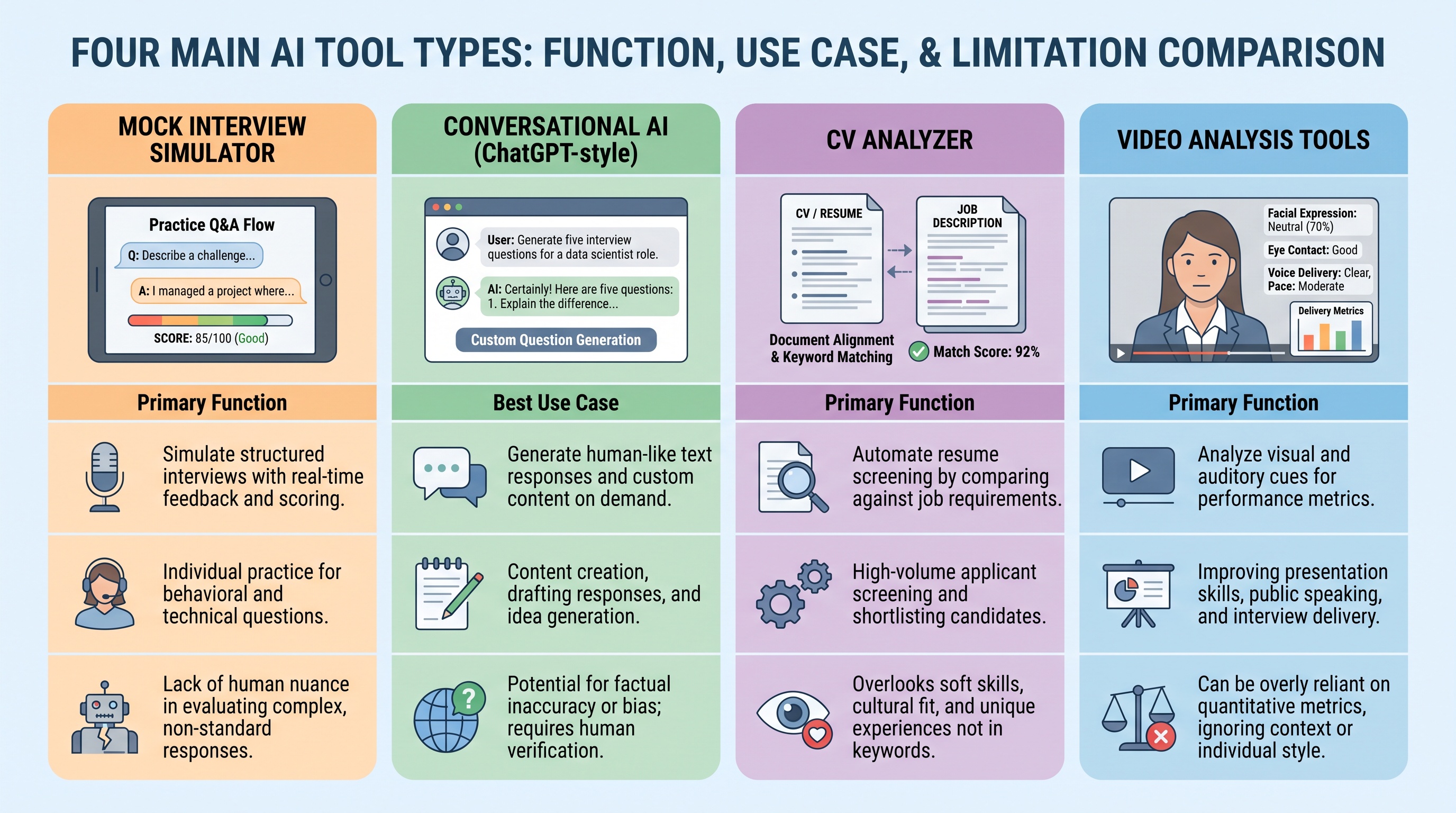
Different AI tools serve different parts of the interview preparation process, and understanding their scope helps you combine them effectively rather than overlap.
| Tool Type | Primary Function | Best For | Limitation |
|---|---|---|---|
| AI Mock Interview Simulator | Asks questions, records answers, scores delivery | Behavioral and competency questions | Limited industry-specific depth |
| Conversational AI (e.g., ChatGPT) | Generates custom questions, critiques answers on request | Role-specific or niche technical prep | No real-time voice analysis |
| AI CV and Profile Analyzer | Aligns your experience narrative with the job description | Identifying talking points from your own background | Does not simulate dialogue |
| Video Analysis Tools | Analyzes facial expression, pacing, filler words | Improving non-verbal delivery | Does not evaluate content quality |
The most effective approach combines at least two types: a simulator for repetition and a conversational AI for depth. SmartlyWay’s career tools are built around this layered logic, helping professionals prepare across content, delivery, and strategy.
How to Run a Useful AI Mock Interview
A useful AI mock interview requires more than just pressing start. Framing the session correctly determines the quality of practice you get out of it.
Start by giving the tool full context: paste the job description, your target role title, and the industry. Without this, most AI simulators generate generic questions that do not reflect what the actual hiring team will ask. A senior product manager interview at a fintech company looks very different from one at a logistics startup.
After each answer, do not immediately move on. Ask the tool to evaluate your response against three criteria: clarity, relevance, and specificity. Then rephrase the answer once and compare. This active iteration is where most improvement happens.
| Session Step | What to Do | Common Mistake |
|---|---|---|
| Setup | Paste the full job description | Using generic role title only |
| Practice round | Answer out loud, then review transcript | Typing answers instead of speaking |
| Feedback loop | Ask for specific critique, not general score | Accepting a score without understanding why |
| Iteration | Rephrase weak answers immediately | Moving on without improving the answer |
Tackling Behavioral Questions with AI Help
Behavioral questions follow a predictable pattern: describe a situation, explain what you did, and share what happened as a result. This is the STAR framework (Situation, Task, Action, Result), and AI tools are particularly good at identifying when your answers are missing one of these layers.
A common problem for mid-career professionals is over-indexing on situation context and under-explaining results. If you spend two minutes describing the backstory of a project crisis but only one sentence on what you actually achieved, the interviewer walks away without a clear picture of your impact. AI feedback catches this pattern in seconds, something even experienced practice partners often miss.
To build a strong behavioral answer bank, feed the AI five to seven real examples from your career history and ask it to map each one to common question categories: leadership, conflict, failure, and influence. You end up with a flexible library, not a set of memorized scripts.
A well-structured behavioral answer is not a story. It is evidence. The situation is just the label on the file; the result is what the interviewer actually reads.
Preparing for Technical and Role-Specific Questions
Technical interview preparation benefits significantly from AI because the question space is large but not infinite. Most roles draw from a recognizable pool of scenario-based or knowledge questions, and AI can generate representative versions of these quickly.
For roles in project management, marketing, operations, or finance, ask a conversational AI to generate ten role-specific scenario questions based on the job description. Then answer each one in writing or out loud, and request a rubric-based critique: does the answer demonstrate understanding of the domain, use of frameworks, and awareness of trade-offs?
For highly technical roles such as software engineering or data science, AI simulators can generate coding or case problems. However, their evaluation of technical depth is less reliable than a human reviewer. Use them for volume practice and self-review, not as a final quality check.
Your Pre-Interview AI Preparation Checklist
Use this checklist in the five to seven days before your interview to structure your AI-assisted preparation in a focused, progressive way.
- Day 1: Paste the job description into a conversational AI and generate 15 role-specific interview questions. Sort them by type: behavioral, technical, situational.
- Day 2: Run your first full mock interview session using an AI simulator. Record yourself if possible.
- Day 3: Identify your three weakest answers and rework them using the STAR framework. Ask the AI to score the revised versions.
- Day 4: Map your career examples to the most common behavioral categories. Build a reference sheet with one strong example per category.
- Day 5: Research the company using AI to summarize recent news, strategy signals, and relevant industry challenges. Prepare two to three informed questions to ask the interviewer.
- Day 6: Run a final timed mock session. Focus on pacing, filler word reduction, and keeping answers under two minutes.
- Day 7 (interview day): Review your example reference sheet, not new material. Confidence comes from repetition, not last-minute cramming.
Common Mistakes When Using AI to Prepare
AI interview tools are only as useful as the way you use them. Several patterns consistently reduce their effectiveness for job seekers.
Treating AI feedback as a final verdict is the most common error. A high score from an AI simulator does not guarantee success with a human interviewer, who will read tone, energy, and interpersonal fit in ways no current tool fully replicates. Use AI scores as directional signals, not pass/fail grades.
Another mistake is preparing in writing only. Most interviews happen in real-time conversation. If your entire practice has been typing answers, you have not trained the skill you actually need. Always speak your answers out loud, even when using a text-based AI tool.
Finally, some candidates use AI to generate answers they have not actually lived. Interviewers probe for detail, and a rehearsed answer built on a fictional story collapses under follow-up questions. Use AI to sharpen real stories, not manufacture them.
Frequently Asked Questions
Can AI tools fully replace human mock interviews?
No. AI tools excel at volume practice, instant feedback, and question generation, but they cannot replicate the interpersonal dynamics of a real interview. Human mock interviews are still valuable for reading energy, handling unexpected follow-ups, and practicing rapport. Use AI for daily repetition and humans for final-stage rehearsal.
How many AI mock interview sessions should I do before an interview?
There is no universal number, but three to five focused sessions over five to seven days tend to produce clear improvement for most professionals. The quality of each session matters more than the total count: reviewing and iterating on weak answers is more effective than running the same session repeatedly.
Is AI interview preparation useful for senior or executive roles?
Yes, though the approach shifts. Senior candidates benefit more from using AI to stress-test their strategic narrative and executive presence than from basic question drilling. Ask AI tools to evaluate whether your answers demonstrate systems thinking, leadership judgment, and business impact, not just task execution.
What information should I give an AI tool to get the most relevant practice questions?
Provide the full job description, your target role title, the industry, company size or type if known, and a brief summary of your background. The more specific the input, the more relevant the questions. Vague inputs produce generic outputs that do not reflect the real interview.